Why Masjid Amanah exists
Every UK masjid is a registered charity — bound by law, entrusted by its community, and responsible for assets that belong to Allah الله سبحانه وتعالى. Some are navigating governance difficulties. Most are simply doing their best with tools that were never built for them — WhatsApp groups, spreadsheets, and goodwill holding together what should be a properly managed institution.
Masjid Amanah exists for both. A complete management platform purpose-built for UK masajid — governance, finance, welfare, education, HR, and more — that turns obligation into simplicity and complexity into clarity. Whether your masjid needs to fix something or simply wants to run better, this platform was built for you.
And it changes what membership feels like. For the first time, members see their masjid clearly — where money goes, how decisions are made, what projects are underway and why. A significant spend is no longer a rumour or a notice on a wall; it is visible, explained, and accountable. Parents and imams connect directly, communities are consulted rather than simply informed, and the people a masjid serves can finally engage with it — not as outsiders, but as the trust-holders they were always meant to be.
From informed to consulted. A small change in words. A profound change in trust.
UK masajid are charities — and most are doing their best without the right tools
There are over 1,800 registered masjid charities in England and Wales. Each is legally required by the Charities Act 2011 to operate in accordance with its governing document, maintain proper trustee oversight, and act in the interests of its beneficiaries. Most trustees take this responsibility seriously. The problem is not intention — it is infrastructure.
Even well-run masajid find governance a burden. Arranging a meeting, circulating an agenda, taking minutes, distributing them, tracking a complaint, managing a financial approval — each task done manually adds friction. When a WhatsApp message is faster, people use WhatsApp. Not because they want to avoid compliance, but because no easier compliant alternative has ever existed. Masjid Amanah is that alternative.
Charity law is clear
The Charities Act 2011 and Charity Commission guidance are unambiguous: trustees must act in accordance with the governing document. Failure to do so is a breach of duty — regardless of intention. Most trustees don't know what they don't know. That is what Masjid Amanah fixes.
The gap is systemic
Paper records, WhatsApp groups, and informal meetings are how most masajid operate — not out of negligence, but because nothing better has existed. Masjid Amanah replaces that patchwork with one compliant, automated platform that makes doing the right thing the easiest thing.
Communities deserve better
When governance works, communities thrive. When it fails — through negligence or simply through the absence of proper tools — the masjid becomes a site of conflict rather than worship. The goal of Masjid Amanah is simple: make proper governance the path of least resistance for every masjid.
It started with a question
Masjid Amanah was not born in a boardroom. It was born from direct, personal experience — watching governance fail at close range, and recognising that the same patterns repeat themselves quietly and consistently in masajid up and down the country.
The failures are rarely malicious. In almost every case the people involved are trying their best. But without the right tools, the right knowledge, and the right structure, even well-intentioned trustees can find themselves acting outside the authority the constitution grants them — sometimes without even knowing a constitution exists that constrains what they can and cannot do.
AGMs missed or improperly convened. Elections conducted informally. Complaints buried not out of malice but out of not knowing the right process. Assets managed without oversight not because of dishonesty but because no system existed to make oversight easy.
That observation led to a single question: why does no system exist to prevent this?
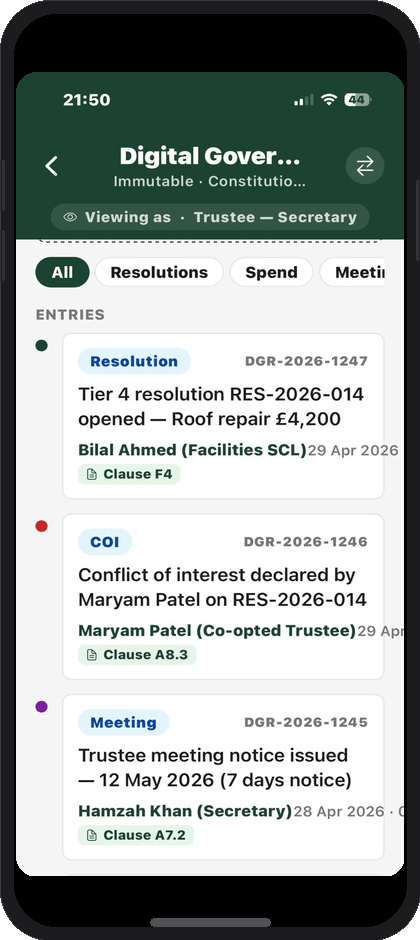
Masjid Amanah is the answer. Not a lobbying effort, not a legal action — but a platform. One that makes doing the right thing the easiest thing. One that turns the constitution into the system — so that every masjid, regardless of where it is starting from, has the infrastructure to govern with confidence.
A not-for-profit platform.
Built for the sake of Allah.
Not-for-profit
Masjid Amanah is not a commercial venture. There are no plans to charge masajid. We are building this because it is needed — because the ummah deserves infrastructure built for its benefit, not for profit.
UK charity law grounded
Every feature is designed with reference to the Charities Act 2011, Charity Commission guidance (CC3, CC29, CC36), and the governance obligations of registered masjid charities. We do not guess at compliance — we build it in from the start.
For every masjid
Masjid Amanah is multi-tenant — one platform, many masajid. Each masjid configures its own constitution. The platform enforces it. Whether a masjid is navigating governance difficulties or simply wants to operate better, there is no prerequisite for joining. Every masjid starts from where it is.
36 modules. 7 pillars. 3 phases.
Governance is the foundation, but the platform extends across the full lifecycle of a masjid. Finance, HR, education, welfare, funerals, events, safeguarding, security — every capability purpose-built for UK masajid, delivered in phases, and growing with the communities that use it.
not-for-profit · no plans to charge · for the sake of Allah سبحانه وتعالى
Be part of the solution
Whether you represent a masjid, a Muslim professional, a developer, or simply someone who cares about the future of our masajid and the communities they serve — there is a place for you in this project.